Pre-arbitration and arbitration are the last stages of the card network dispute process. A dispute reaches these stages when the issuing bank rejects your response to the dispute.
Finix supports pre-arbitration and arbitration. You can view information about the pre-arbitration and arbitration stages in the Finix Dashboard.
| Stage | What happens |
|---|---|
| Pre-arbitration | The issuing bank rejects your response and explains why. You can accept liability, or challenge again with new evidence. |
| Arbitration | The card network reviews the case under its rules and makes the final decision. The side that loses is responsible for the disputed amount and typically pays the card network's arbitration fees. |
These stages are the reason a WON or LOST Dispute isn't always final. For more information, see Winning and losing disputes.
For help with a specific pre-arbitration or arbitration case, contact the Finix Support team.
When the issuing bank opens pre-arbitration on one of your Disputes, the Dispute's page in the Finix Dashboard shows an Action Required message.
To respond:
- Log in to your Finix Dashboard and open the Dispute.
- Under Your Response, open the file named Issuer's Pre-Arbitration Information. This file contains the issuing bank's notes on why it rejected your response.
- Upload new documents that address the issuing bank's notes. The issuing bank already rejected your earlier evidence, so submitting it again isn't enough. You can upload JPG, PNG, or PDF files up to 2 MB each, and keep your evidence to 8 files or fewer. For tips on building new evidence, see Preparing dispute evidence.
- Click Challenge Dispute and submit your response.
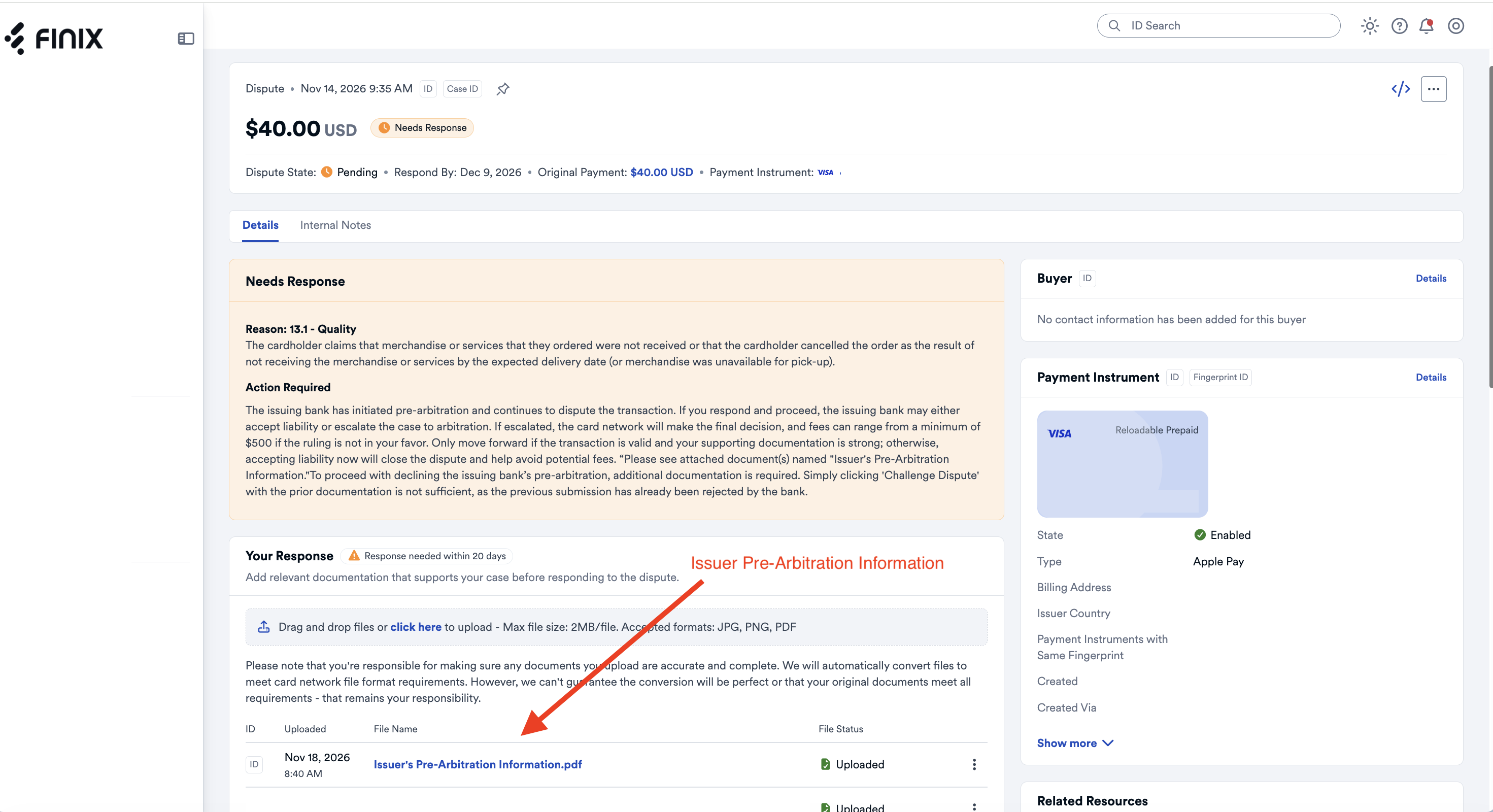
If you accept liability, the dispute closes and you're responsible for the disputed amount. If you challenge, the issuing bank can accept your response or escalate the case to arbitration. If the card network rules against you, network fees apply on top of the disputed amount, so challenge only when your new evidence is strong. For more information, see Network fees.
Consider responding when:
- The issuing bank's notes are incorrect, and you have documents that show it.
- You have new evidence that you didn't include in your first response.
- The disputed amount is high enough to justify the possible arbitration fees.
Consider accepting liability when:
- You have no new documents that address the issuing bank's notes.
- The disputed amount is lower than the possible arbitration fees.
Respond before the Respond By date on the Dispute's page. A missed deadline counts as accepting liability for the dispute.
Each card network handles pre-arbitration differently.
| Card network | Pre-arbitration supported | What happens after your response |
|---|---|---|
| Visa | Yes | If the issuing bank rejects your response, the case moves to pre-arbitration and you can respond again. |
| Mastercard | Yes | If the issuing bank rejects your second presentment, it opens pre-arbitration and you can respond again. |
| American Express | No | American Express makes the final decision. |
| Discover | Yes | If the issuing bank rejects your response, it can open pre-arbitration and you can respond again. |
Visa sends each dispute through one of two flows, based on the dispute reason.
| Visa flow | Visa dispute categories | What happens after your response |
|---|---|---|
| Allocation | Fraud (category 10) and Authorization (category 11). | If the issuing bank rejects your response, the case moves to pre-arbitration. You can respond with new evidence. If you don't respond, you're responsible for the dispute. |
| Collaboration | Processing Errors (category 12) and Consumer Disputes (category 13). | If the issuing bank rejects your response, it opens pre-arbitration and explains why. You can respond with new evidence. If you don't respond, you're responsible for the dispute. |
Mastercard calls a dispute a chargeback and calls your response to it a second presentment.
If the issuing bank rejects your second presentment, it opens a pre-arbitration case and explains why. You can respond with documents that address those reasons. If you don't respond, you're responsible for the chargeback.
Three Mastercard reason codes skip pre-arbitration. If the issuing bank rejects your second presentment on one of these chargebacks, it can escalate directly to arbitration.
| Mastercard reason code | Chargeback reason |
|---|---|
4808 | Authorization-related chargeback. |
4870 | Chip liability shift. |
4871 | Chip and PIN liability shift. |
American Express doesn't have a pre-arbitration or arbitration stage. American Express reviews your response to the chargeback and makes the decision. If American Express rejects your response, you lose the chargeback and the decision is final.
Discover's process is similar to Mastercard's. If the issuing bank rejects your response to the dispute, it can open pre-arbitration.
In arbitration, the card network reviews the case and makes the final decision. Keep the following in mind before a case reaches this stage:
- No new evidence: The card network reviews the evidence already submitted during the dispute and pre-arbitration. You can't add evidence at this stage, so include everything in your pre-arbitration response.
- Final decision: The card network's decision is binding on you and the issuing bank.
- Timeline: Arbitration can take several months.
- Fees: The side that loses typically pays the card network's arbitration fees. For more information, see Network fees.
How a case reaches arbitration depends on the card network.
| Card network | Visa flow | Arbitration | How a case reaches arbitration |
|---|---|---|---|
| Visa | Allocation | Yes. Visa makes the final decision. | If you respond to pre-arbitration and the issuing bank still disagrees, the case can be escalated to Visa for arbitration. |
| Visa | Collaboration | Yes. Visa makes the final decision. | If you respond to pre-arbitration and the issuing bank still disagrees, it has 10 days to escalate the case to Visa for arbitration. If the issuing bank doesn't escalate in time, it's responsible for the dispute. |
| Mastercard | Not applicable. | Yes. Mastercard makes the final decision. | If you respond to the pre-arbitration case and the issuing bank still disagrees, it has 15 days to escalate to an arbitration case. If the issuing bank doesn't escalate in time, it's responsible for the chargeback. |
| American Express | Not applicable. | No. The American Express decision on your response is final. | Not applicable. |
| Discover | Not applicable. | Yes. Discover makes the final decision. | If you respond to pre-arbitration and the issuing bank still disagrees, the case can be escalated to Discover for arbitration. |
The card networks charge fees at the arbitration stage. These fees can be higher than the disputed amount.
| Fee | When the card network charges it | Amount |
|---|---|---|
| Filing and ruling fees | For the card network's arbitration review. The card network typically charges the side that loses. | Can exceed $500 per case. |
| Technical violation fees | For breaking a procedural rule during pre-arbitration or arbitration, such as missing a deadline or sending invalid documents. These fees can apply even if you win the case. | Can exceed $250 for each violation. |
Card network arbitration fees can be passed through to you and your merchants.