Understand the dispute process end to end so you know what happens when a cardholder challenges a payment, what it costs, and how it resolves.
A dispute happens when a cardholder contacts their issuing bank to challenge a payment. The card networks manage the process, and each network follows its own rules. Finix represents each dispute as a Dispute resource and guides you through responding to it.
When a card network creates a dispute, Finix:
- Records a new Dispute on the Finix Dashboard.
- Sends an email or webhook for every new Dispute, if you subscribe to notifications.
- Provides the Dispute details, including the reason code, card network, and your opportunity to challenge the Dispute.
To monitor and act on Disputes, see Managing disputes.
A dispute follows the same general process across card networks, though the exact steps and timing vary by network.
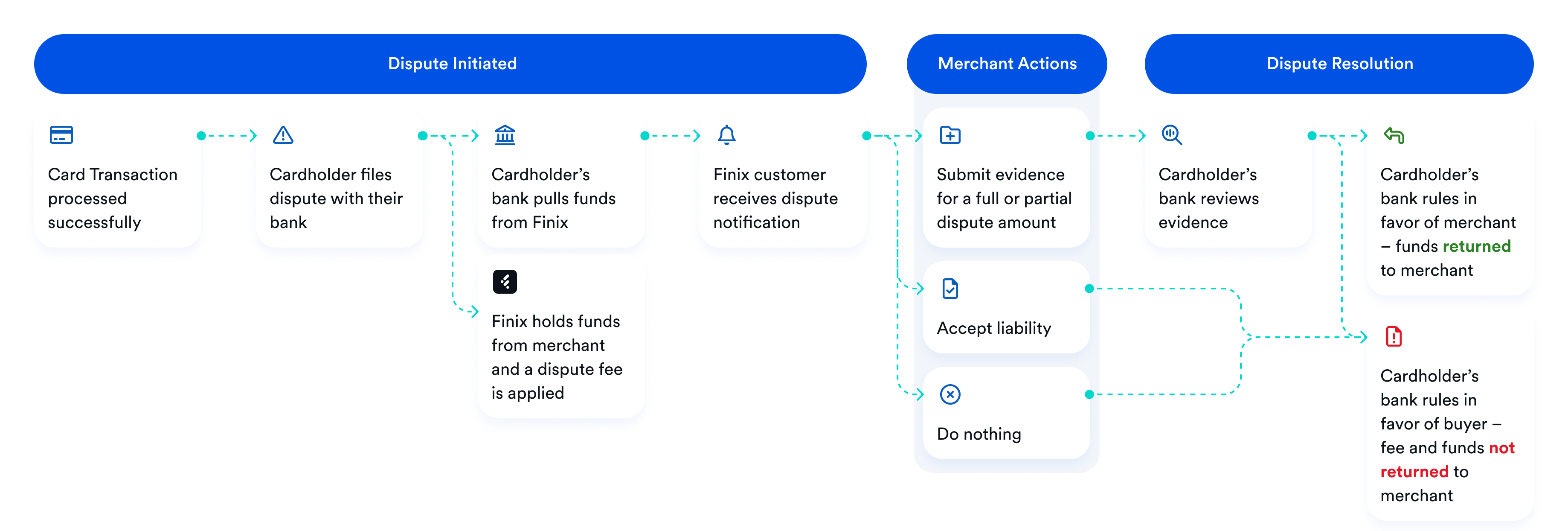
This process may differ across card networks for some specific disputes. To receive notifications for disputes, subscribe to Finix's webhooks.
The process starts when a buyer believes they were charged incorrectly and disputes the transaction with their issuing bank. Disputes often happen when buyers see charges on their statements that they don't recognize. The issuing bank reverses the payment and notifies Finix, and Finix debits the disputed amount from the relevant Merchant account. Throughout the process, the issuing bank gives the merchant opportunities to provide evidence that the charge is legitimate.
A chargeback is the formal network phase that involves the first movement of money. A dispute may start as a chargeback or escalate to one from an inquiry.
When a dispute is a chargeback, Finix pulls funds from you if you are a direct merchant, or from your merchants if you are a platform. Finix creates a MERCHANT_DEBIT Transfer, places it into a Settlement, and reduces the amount that would have been paid out to the merchant. The funds are held for the duration of the dispute. The held amount may be the full transaction amount or a different amount, depending on the dispute details.
For information on how disputes work for split transactions, see Split Transactions - Disputes.
Before a chargeback, some card networks add a preliminary stage that Finix refers to as an Inquiry. This stage is also known as a retrieval request or a request for information.
Only American Express and Discover use inquiries; Visa and Mastercard have discontinued them. Respond to every inquiry to prevent it from escalating into a chargeback.
| Card Network | Inquiry Supported |
|---|---|
| American Express | Yes |
| Discover | Yes |
| Visa | No |
| Mastercard | No |
If you don't respond to an American Express or Discover inquiry, it turns into a chargeback that can't be challenged.
After a chargeback is created, you have a limited time to respond to the card issuer. This ranges from 7 to 21 days, depending on the card network.
If you submit evidence, the issuer has a limited time to evaluate it and reach a decision. This ranges from 60 to 75 days, depending on the card network.
From start to finish, the dispute process typically spans two to three months. The only way to shorten this timeline is to accept the Dispute through the Dashboard or API. In rare cases, the process may take up to six months.
The date by which a dispute must be responded to is subject to change based on updates Finix receives from the card networks.
Finix charges a fee for the creation of inquiries and chargebacks. Both events create Dispute resources, so a single dispute may incur two fees: one for the initial inquiry and one for the eventual escalation to a chargeback.
If you are a platform, Finix generates Costs for these events. You can pass them on to your merchants as Fees using Merchant Fee Profiles.
At the end of the process, the issuing bank rules in favor of either the merchant or the buyer.
The issuing bank reviews the evidence and rules in favor of the merchant. The issuing bank returns the debited chargeback amount to Finix, and Finix returns the amount to the merchant.
The issuing bank reviews the evidence and rules in favor of the buyer. No extra money movement occurs when the buyer wins.
The networks may signal a provisional credit granted to the merchant. If the dispute is ruled in favor of the buyer, Finix pulls funds again to settle the difference.
Finix tracks the outcome of a Dispute with a WON or LOST state. Because disputes are asynchronous, this state may take up to two months to update. These states are not final: the networks or the cardholder may overturn them on further escalation.
- A
LOSTDispute may flip toWONon further escalation from the cardholder, acquirer, issuer, or network. The merchant receives their funds back if this happens. - A
WONDispute may flip toLOSTon further escalation from the cardholder, acquirer, issuer, or network. The merchant has funds pulled if this happens.
For the full set of Dispute states, response states, and reason codes, see Dispute states.